
Overview of Pocket Watches
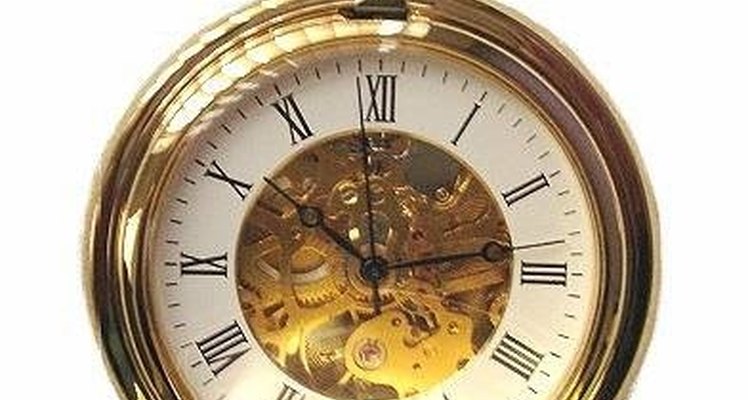
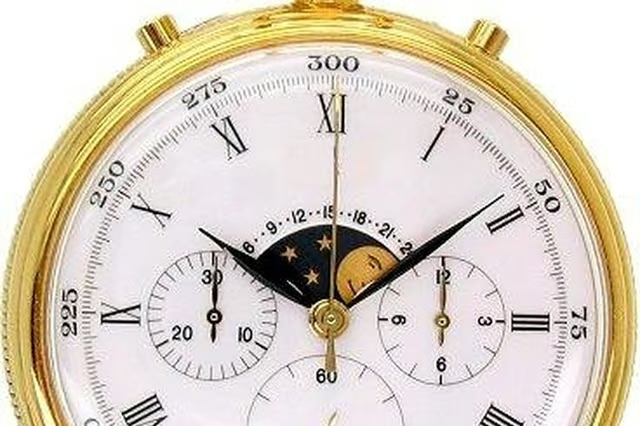
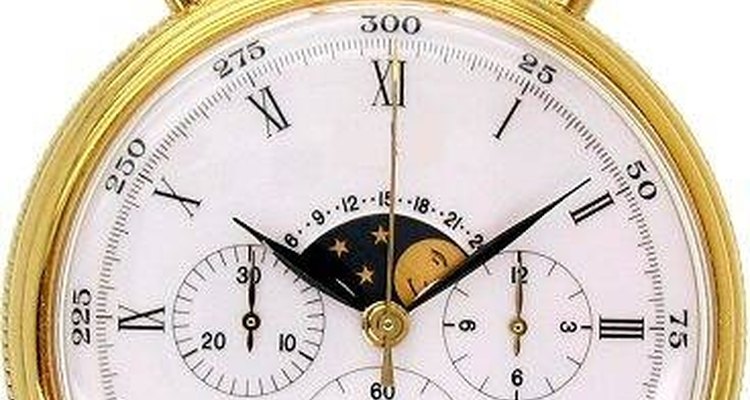
Pocket watches were invented in the 16th century, and they remained popular until World War I. Although pocket watches have largely been replaced by wrist watches in modern society, a number of watch manufacturers continue to produce pocket watches. There are two main types of pocket watches: open face and hunter-case. Open-face watches have the main winding knob at the top of the dial and the seconds sub-dial at the bottom of the dial. Hunter-case watches have a spring-hinged metal cover, which is used to protect the watch face from debris and damage. Most modern hunter-case watches have the lid hinged at the bottom of the dial, and the winding knob and seconds sub-dial in the same places as an open-face watch.
Mechanics of a Pocket Watch

Pocket watches have five main mechanical components: a mainspring, a gear train, a balance wheel, an escapement mechanism and a clock face. The mainspring becomes compressed when a pocket watch is wound, and this mechanical energy is used to power the watch. The mainspring is attached to a cylindrical barrel with gear teeth. The barrel's gear teeth turn the gear train, which consists of four separate wheels attached to one another with additional gear teeth. The barrel is directly attached to the center wheel, which is then attached to the escapement mechanism. The escapement mechanism is a pendulum that rocks back and forth with each rotation of the center wheel. One end of the escapement mechanism is attached to an upright pin on the balance wheel. The movement of the escapement mechanism causes the balance wheel to advance in regular intervals, thereby allowing the watch to keep time. Attached to the balance wheel is a cannon pinion that attaches to the minute wheel. The cannon pinion also drives a small 12-1 gear reduction mechanism that rotates the hour wheel once for every 12 rotations of the minute hand. Both the hour and minute wheels contain shafts going through the clock face and attaching to the watch hands.
Pocket Watch Jewels
You can often determine the quality of a pocket watch by counting the number of jewels it contains. Jewels are inserted into the areas of a pocket watch that have the highest amount of mechanical movement in order to minimize wear and tear. Seven is generally considered the lowest acceptable jewel count for a quality pocket watch, with most modern watches containing 17 to 21 jewels. A quality pocket watch should have the jewel count engraved on the cover or back of the watch.