


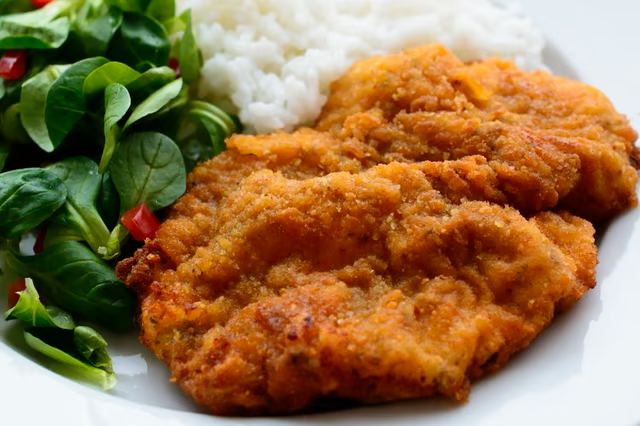
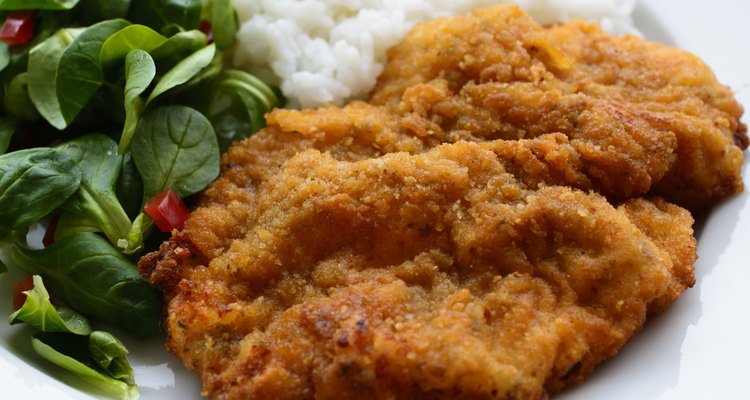
Believe the hype about the superior cooking results you'll get from a convection oven, as compared to a conventional oven. Convection ovens come with a fan that circulates the hot air in the oven, ensuring that all sides of whatever you are preparing cooks and browns evenly, at the same time and about 25 percent faster than conventional ovens. Those breaded pork tenderloins you planned to bake for sandwiches or those chicken tenders that you're making to serve with various dipping sauces will cook faster, crispier and more evenly in your convection oven.
Preheat your convection oven. Because convection ovens cook significantly faster than traditional conventional ovens, in most cases, you should set your oven about 25 degrees lower than what a recipe calls for. Both breaded pork and breaded chicken tenderloin recipes typically call for them to be baked between 400 and 425 degrees Fahrenheit in a traditional oven, so set your convection oven from 375 to 400 degrees.
Trim the pork tenderloin of the shiny, silvery fat, it if has not already been removed. Slide the tip of your chef's knife just underneath and cut down the length of the tenderloin to remove the fat. Chicken tenderloins, much smaller than pork, generally come with several packaged together and are typically fully trimmed of fat. Trim any excess fat you see, however.
Cut the pork tenderloin crosswise into medallions, or diagonally into thick oblongs. Cover the pieces with plastic wrap and pound them with a mallet until they are about 1/4 inch thick. Chicken tenderloins are small and thin and do not need additional preparation.
Prepare a breading for your pork or chicken tenderloins. First prepare an egg wash by scrambling one or two eggs with a little water in a shallow bowl. Pour breadcrumbs into another bowl. You can season the breadcrumbs however you like with seasonings, such as salt, pepper, garlic powder, paprika and dried Italian herbs.
Dip the pork or chicken tenderloins, one at a time, first into the egg wash, then into the breadcrumbs. Turn the tenderloins over a few times in the crumbs to ensure both sides are fully ad evenly coated. Put the breaded tenderloins onto a wire rack sitting on a baking sheet lined with aluminum foil.
Place the rack in the preheated oven and bake the breaded tenderloins for roughly 10 to 20 minutes, or until the breading is golden brown. Although the pork and chicken tenderloins are different shapes, because of their thinness, they generally should have similar cooking times. However, pork must be cooked to at least 145 degrees Fahrenheit and chicken tenderloins must be cooked to 165 degrees for safe consumption, according to the Food and Drug Administration. Insert a meat thermometer directly in the center of each tenderloin to check the temperature.